 English
 English
 Português
 Español

A DEOW Japan manga student just made history. Here’s how it happened — and what it means for aspiring manga artists everywhere.
There’s a moment in volleyball when a substitute steps off the bench and changes the entire match. Five minutes. That’s all it takes.
That same idea sits at the heart of 5分のエース — Go Fun no Ace (Five Minutes Ace) — the debut manga series by Gin, a 25-year-old artist from Uruguay who has just become the only active Latin American mangaka inside a Japanese publisher.
This isn’t a story about luck. It’s a story about a plan, a program, and years of quiet, deliberate preparation. And it started with DEOW Japan.
Who Is Gin?
Gin’s real name is Guillermo Vitale. At age 8, his father handed him a copy of Naruto, and something shifted. He didn’t just fall in love with manga — he decided, with unusual clarity for a child, that he would one day make it.
By 14, he was studying Japanese. Not as a hobby. As a plan.
He grew up in Uruguay playing competitive volleyball and drawing obsessively, two passions that would eventually merge into a single, deeply personal manga. But the dream of publishing in Japan — in the industry’s heartland, in Japanese, with a real editorial team behind him — required more than talent. It required a path.
That path was DEOW Japan’s Global Tokiwaso Project.
What Is the Global Tokiwaso Project?
ost international artists who dream of making manga in Japan face the same wall: language barriers, no industry contacts, and no clear way in. Language schools teach Japanese. Art programs teach technique. But almost nothing bridges those two worlds and connects you directly to the professional manga industry itself.
The Global Tokiwaso Project was built to be that bridge.
Named after the legendary Tokiwa-so apartment building in Tokyo — the creative residence where Osamu Tezuka (creator of Astro Boy) and other foundational manga artists once lived and worked side by side — DEOW Japan’s program puts international creators inside that same culture of shared ambition. Participants live and work in Japan, surrounded by mentors, editors, and fellow artists who are all pushing toward the same goal: professional publication.
What sets it apart from a standard study abroad or art course:
- Direct industry mentorship from active manga professionals and editorial contacts
- Portfolio development aligned with what Japanese publishers actually want to see
- Contest submission support — structured entry into the competitions that serve as the real gateway to the industry
- Publisher access — real opportunities to submit completed work to Japanese houses
It’s not a taste of the manga world. It’s an attempt to break into it for real.
The Milestones That Proved the Program Works
Gin’s path to publication wasn’t a single breakthrough moment. It was a series of them, each one building on the last.
June 2025 — Shogakukan Sunday Webry Newcomer Award Finalist
His submission, 「5分のエース」, was selected as a finalist in one of Japan’s most respected newcomer manga competitions, run by Shogakukan — the same publisher behind Detective Conan, Pokémon, and Doraemon. The recognition came with a ¥10,000 prize, but more importantly, it put his work in front of professional editors at one of the biggest names in Japanese publishing.
April 10, 2026 — Serialization in Manga Zegra
Go Fun no Ace began serialization in Manga Zegra, a digital shonen magazine. Crucially, the first chapter was given the lead color opening — a spotlight position that publishers typically reserve for series they believe in. For an international debut artist, this was extraordinary.
July 10, 2026 — Launch on Piccoma
The manga is now available on Piccoma, one of Japan’s major digital manga platforms, expanding its reach to a broader Japanese audience. The website gofunnoace.com is actively building an international community around the series — collecting registrations from readers who want to know when it arrives translated in their language, and from fans who want to support a physical edition for Latin America.
What Is Go Fun no Ace About?
Volleyball manga lives in a crowded genre. Haikyuu!! set an almost impossibly high bar. So Gin did something smart: he didn’t try to cover the whole game. He zoomed in.
Go Fun no Ace centers on a first-year student at Seiran High School who gets unexpectedly thrust into a high-pressure match situation — not as a star, but as someone who has to prove themselves in the few minutes they’re given. The story explores what happens in those compressed, intense moments on the bench and on the court, where the emotional stakes are enormous and every second matters.
It’s a sports manga, but it’s really a manga about pressure, identity, and what you do when you finally get your chance.
In that sense, it mirrors Gin’s own story rather perfectly.
Why This Moment Matters Beyond One Artist
Gin is believed to be the first manga artist from Uruguay to debut in a Japanese commercial manga publication. But the significance of that extends well beyond national pride.
The Japanese manga industry is notoriously difficult for international creators to penetrate. Language, cultural context, industry access, editorial relationships — each of these is its own barrier. The overwhelming majority of manga published in Japan is still created by Japanese artists, for Japanese audiences, within an industry built almost entirely around domestic talent pipelines.
Gin is the only active Latin American mangaka inside a Japanese publisher. That’s not a footnote. That’s a structural first.
And as Gin himself put it at the time of his serialization announcement:
“After many years of effort, I finally fulfilled my dream of becoming a professional mangaka in Japan. I’d like this to also serve as proof that no matter where in the world you’re born: it’s possible.”
For every aspiring manga artist in Latin America, Southeast Asia, Europe, or anywhere else outside Japan who has looked at the industry and wondered whether there was a way in — this is the most concrete answer anyone has given in a long time.
DEOW Japan’s Manga Programs: Where to Start
Whether you’re a complete beginner who fell in love with manga and wants to try drawing for the first time, or a serious artist ready to pursue publication, DEOW Japan has a structured path.
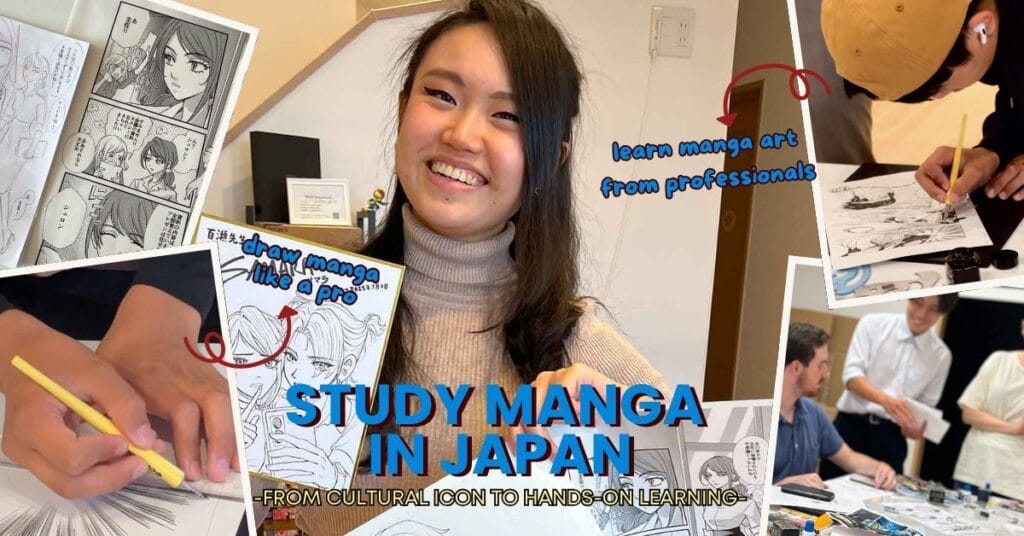
1-Day Manga Foundations Program A hands-on introduction to manga drawing in Tokyo. Perfect for travelers and curious beginners who want a taste of the craft in its home city.
2-Week Intensive Manga Program Held at Casa Tokiwa in Nakano, Tokyo — intentionally named after the legendary creative residence. Small classes of just four students mean genuine, personalized instruction from a professional mangaka. Includes accommodation, guided visits to iconic manga locations, a manga kit, and a Q&A session with a working manga editor.
Private Intensive Manga Program Available both in Tokyo and online. Flexible, one-on-one intensive instruction tailored to your level and goals.
Global Tokiwaso Project The flagship program for serious international artists. Residency in Japan, editorial connections, contest support, and real opportunities to submit to publishers. This is the program Gin was part of. Applications are open.
The Community Around 5 Fun no Ace
DEOW Japan and Gin are actively building something beyond the manga itself. The website at gofunnoace.com functions as a rallying point for international readers who want to see the series grow outside Japan — whether that means a translated edition, a physical release shipped to Latin America, or simply being part of the community that proves there’s a global audience waiting for this.
Registering there sends a signal. A larger community doesn’t just support one artist — it makes a case to the industry that international manga audiences are real, engaged, and worth investing in.
The Bigger Picture
DEOW Japan has been quietly building toward this kind of outcome for years. Their manga programs have always been premised on a belief that the industry is not as closed as it appears — that with the right preparation, the right mentorship, and real immersion in the culture, international artists can break through.
Gin is the proof of concept. But the goal, clearly, is for him to be the first of many.
If you’ve ever read manga and thought I want to make something like this — that instinct deserves a serious answer. DEOW Japan’s programs at jpn-study.com/manga-programs are that answer.
And Go Fun no Ace — serialized, Piccoma-listed, and read in Japan right now — is what the answer looks like when it works.
Follow Gin’s journey on Instagram @gin_mangaka and read his manga on Piccoma. Learn more about DEOW Japan’s Global Tokiwaso Project and all manga programs at jpn-study.com